

Our team sent me videos from the camps last night.
The storm hit last week. Not a drama by our standards: rain and wind, the sort of thing that keeps you awake and is gone by morning.
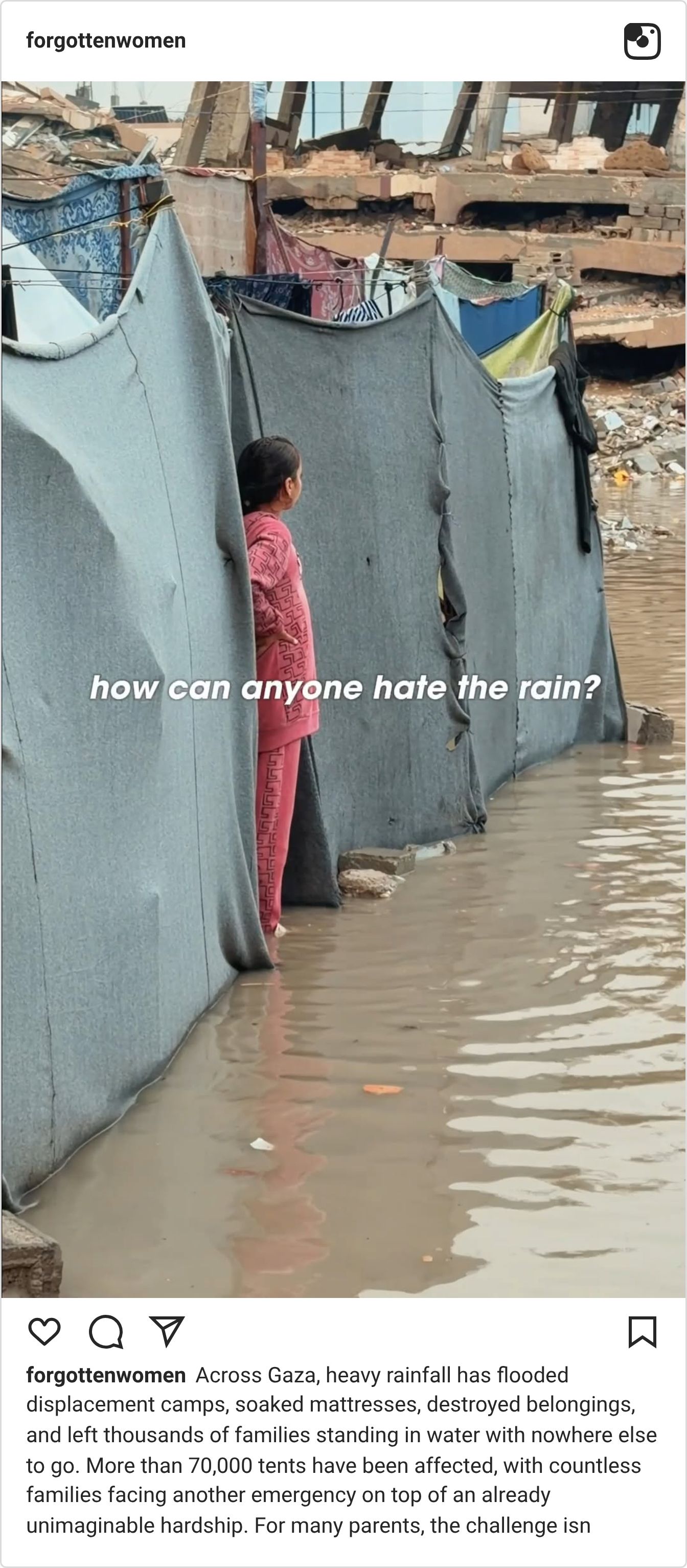
But there are no buildings left to break it, no drains, and nearly two million people living under fabric and plastic sheeting. Around seventy thousand tents went under in twelve hours.
That was six days ago.
In one of the videos, a girl walks our team through what’s left of her home.
She does it the way you’d show someone round a house. This is where we sleep. This is where we keep our things. Here’s the corner where we cook.
All of it underwater.
And behind her, people are mopping.
That’s the part I haven’t been able to put down.
They literally have mops out. They’re pushing water across a floor that is water, into ground that’s already saturated, in the rain, with more rain coming.
It cannot work. Everyone there knows it can’t work.
They’re doing it anyway, because that is what you do when your home floods. You get the water out. It’s the thing your mother did and her mother did, and the instinct doesn’t switch off just because the house is a tarpaulin and the floor is sand and there’s nowhere on earth to push the water to.
So they mop. And it comes straight back.
Not one single inch of anything out there is dry. Not a blanket, not a mattress, not a change of clothes, not a child.
Six days.
Anywhere else, when water comes in, you go somewhere. Upstairs. Next door. A neighbour’s kitchen. There’s always an inside to get to.
The tent is the inside. It’s the thing they ran to. It’s the last place.
So at two in the morning, when the ground turns to water, a mother has nowhere to take her children. Not one square metre of dry floor in any direction. She can hold them, keep them off the ground, and wait for morning.
Except morning didn’t fix it. Neither did the six days after.
Nothing dries out there. No radiator, no dryer, no sun strong enough in November, no spare clothes. Her children are in what they were wearing when the water came, and they’ll be in it tonight.
And that? the staying wet is what kills. Not the storm.
Because hypothermia doesn’t need freezing. Gaza doesn’t get freezing, and I think a lot of us have quietly used that to feel better.
What it needs is wet. Wet, plus a body with nothing left on it after two years of hunger, plus nowhere to get warm. Put those three together and a small child can die at a temperature you’d call a mild evening.
Which means last week’s storm is still killing people today. It never ended. It’s in the bedding.
A child died of the cold there last night.
His mother will have been holding him, the way she had every other night, and it wasn’t enough, because you cannot warm a child from the outside when there’s nothing in him left to burn.
So that girl showing our team around her flooded home, and the people behind her with the mops, aren’t being hopeless. They’re doing the only thing they can with what they’ve got.
They just need something better than a mop.
That’s what we’re sending. Emergency winter kits, going in now, put together for exactly this, for people with nothing dry left, while the bedding is still soaked and more rain is forecast.
The woman who filmed that video was standing in the same water. Our team haven’t left those camps since the storm and they aren’t going to.
Nothing out there is dry tonight.
Help us change that.
For everyone still mopping,
Hafsa