

She was on my screen this morning.
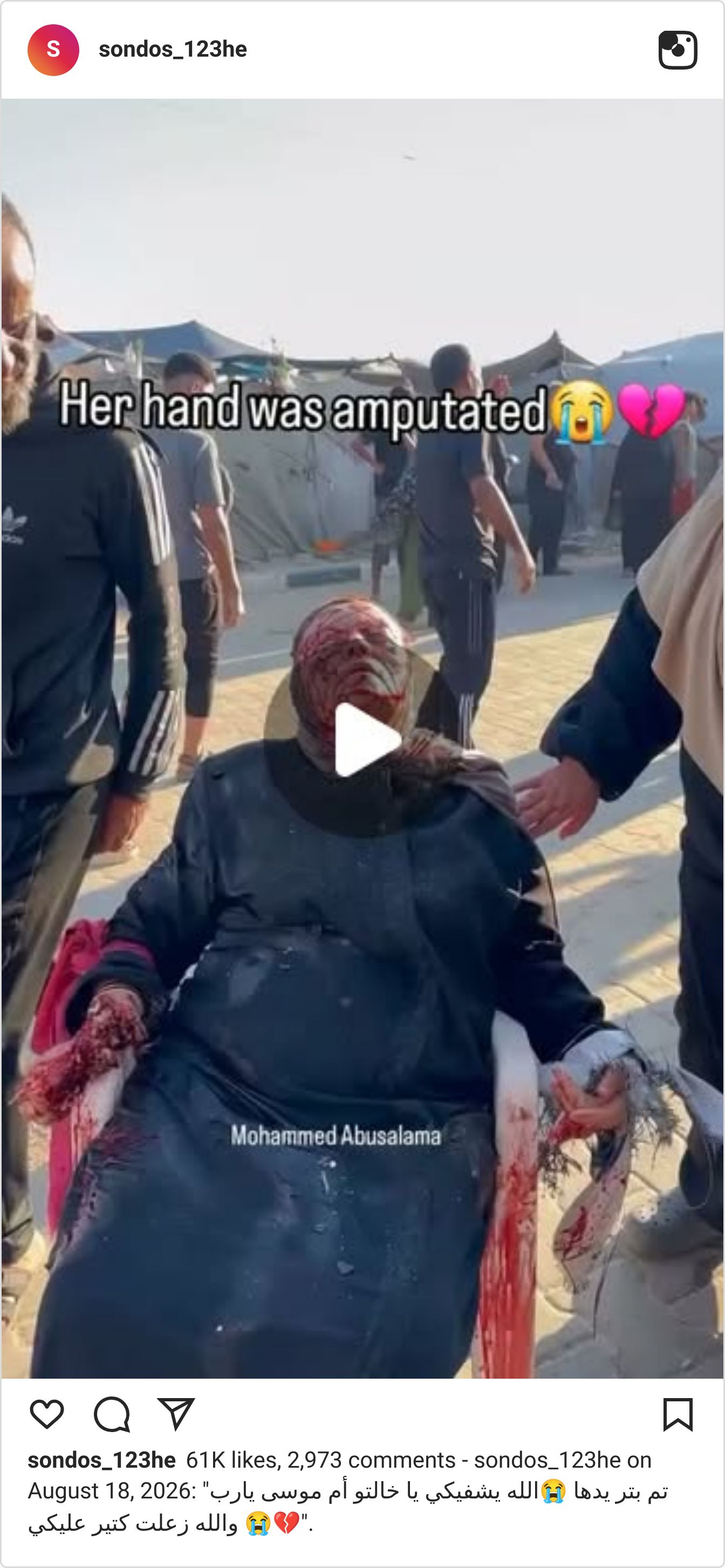
A woman. Fifty, maybe. Her face is bloodied. Not a cut, not a graze, the whole side of it wet and dark. Her arm is gone. Not injured. Not wrapped. Gone, from near the shoulder, the way a branch goes.
And she is alive.
She is alive. She is conscious. There is no morphine in Gaza. There is no anaesthetic. There is barely gauze. There is a woman with her arm blown off her body, awake, in a place where the medicine ran out months ago and the world stopped checking.
She looks like my mother.
She isn't my mother. She is nothing to do with my mother. But the face is my mother's face. The same shape, the same set of the mouth, the same age around the eyes and my body reacted before my mind could stop it and I have not recovered.
Somebody's mother. Somebody who taught a child to hold a spoon. Somebody who has a way of saying a name that only she says.
She doesn't scream. In the video, she doesn't scream.
She turns her face upward. Just that. Lifts her chin toward the sky and holds it there, lips moving, one hand where two used to be.
She is praying for it to end.
And I sat there full, safe, with a paracetamol in the drawer for a headache I might get later and I understood I couldn't tell her when it ends. I don't know when it ends. None of us do. There is no date. There is no mechanism. There is no one coming.
She is asking the only one left who might be listening, because everyone else has already proven they aren't.
I need to admit something.
Before this morning, I had started to think it was easing. Not consciously. Nobody decides that. It happened the way most terrible assumptions happen: quietly, by default, in the space where information used to be.
My feed had gone quiet. The footage thinned. Weeks passed without the images that used to arrive every hour. And somewhere underneath thought, in the part of me that wants to sleep at night, a sentence formed itself: maybe it's stopping.
It isn't stopping.
The silence isn't peace. The silence is what happens when the people holding the cameras are killed. Journalists. Photographers. Young men and women who taught themselves to livestream their own destruction because nobody else would. They filmed until they were filmed. Now their accounts sit still, and we mistake stillness for calm.
We were never watching Gaza. We were watching them watch Gaza. And when they were killed, we didn't lose a news source. We lost our eyes.
Every quiet week you have had was bought. Someone paid for it with their life so you could have a quieter afternoon.
So don't trust the quiet.
Don't let the thinning of images thin your resolve. Don't let a slow news cycle do what no amount of denial could. Persuade you it's over.
It is not over. She is out there right now, this second, as you read this, in a body torn open with nothing to numb it, looking at the sky.
We can't give her an end to this. Nobody can promise her that.
But we can reach her. Food, water, medical supplies. Actual pain relief, actual dressings, actual care, delivered by women who are still there when everyone else has gone.
That is not nothing. When you have no arm and no morphine and no news of when this stops, it is very close to everything.
Don't let the silence finish what the bombs started.
Watching with borrowed eyes,
Hafsa