

It’s been quieter in Gaza this week.
Not quiet. Quieter. Fewer bombs, further away, the kind of stretch where a few days go by without the sound being close.
It happens sometimes. There’ve been four or five of these over the past two years: a lull, a week or so, and then it picks back up. Nobody there ever finds out in advance which kind of quiet they’re in.
And there’s a woman in Gaza right now deciding how much to let her children relax.
That’s a real decision she has to make, every morning, and there’s no right answer to it.
Her kids have noticed. That’s the problem.
Because children don’t do caution. Give them three calm days and they’re back to being children: running further than they should, sleeping properly, laughing at something. Her son went out of sight yesterday and she let him, and she spent the whole time he was gone deciding whether that was a mistake.
And at some point one of them is going to ask her if it’s over.
Do you say yes?
Do you let them have it, let them sleep deeply, let them start sentences with “when we go home”, knowing what you know about how these stretches usually end?
Or do you keep them frightened, on purpose, because frightened children run faster?
That’s the choice. A mother has to ration her own children’s hope, and she has to get the amount exactly right, and nobody can tell her what it is.
I don’t think we talk about this enough.
We talk about the bombs. We don’t talk about what the gaps do.
Because hope isn’t a decision. It’s involuntary. You cannot stop a human being from hoping. Put anyone in three days of quiet and they will start, without meaning to, making plans. Thinking about the house. Wondering about school. Letting their shoulders down an inch.
And then it starts again, and everything they allowed themselves is taken as well.
That’s a particular kind of cruelty and we don’t really have a word for it.
Not the violence. The intermissions. Letting people exhale, and then.
Some of them have been through this four or five times now. They know what a quiet week is. They’ve learned not to trust one, which means they can’t even have the rest properly. They sleep lightly, listening, waiting for it to resume.
Imagine being so used to this that calm makes you nervous.
And the worst of it is that nobody there is guessing. They’ve been told. Senior leadership on the other side said it in print, to a journalist, weeks ago: that the enemy isn’t any armed group. It’s Gaza. The place. The people in it. And that annexation comes next.
So the quiet isn’t a mystery to anyone in those tents. It’s a gap between two parts of the same thing, and they are living inside it with their children, trying to work out how much of it to believe.
That mother is not relieved this week. She’s braced.
And here’s what I’d ask you to notice.
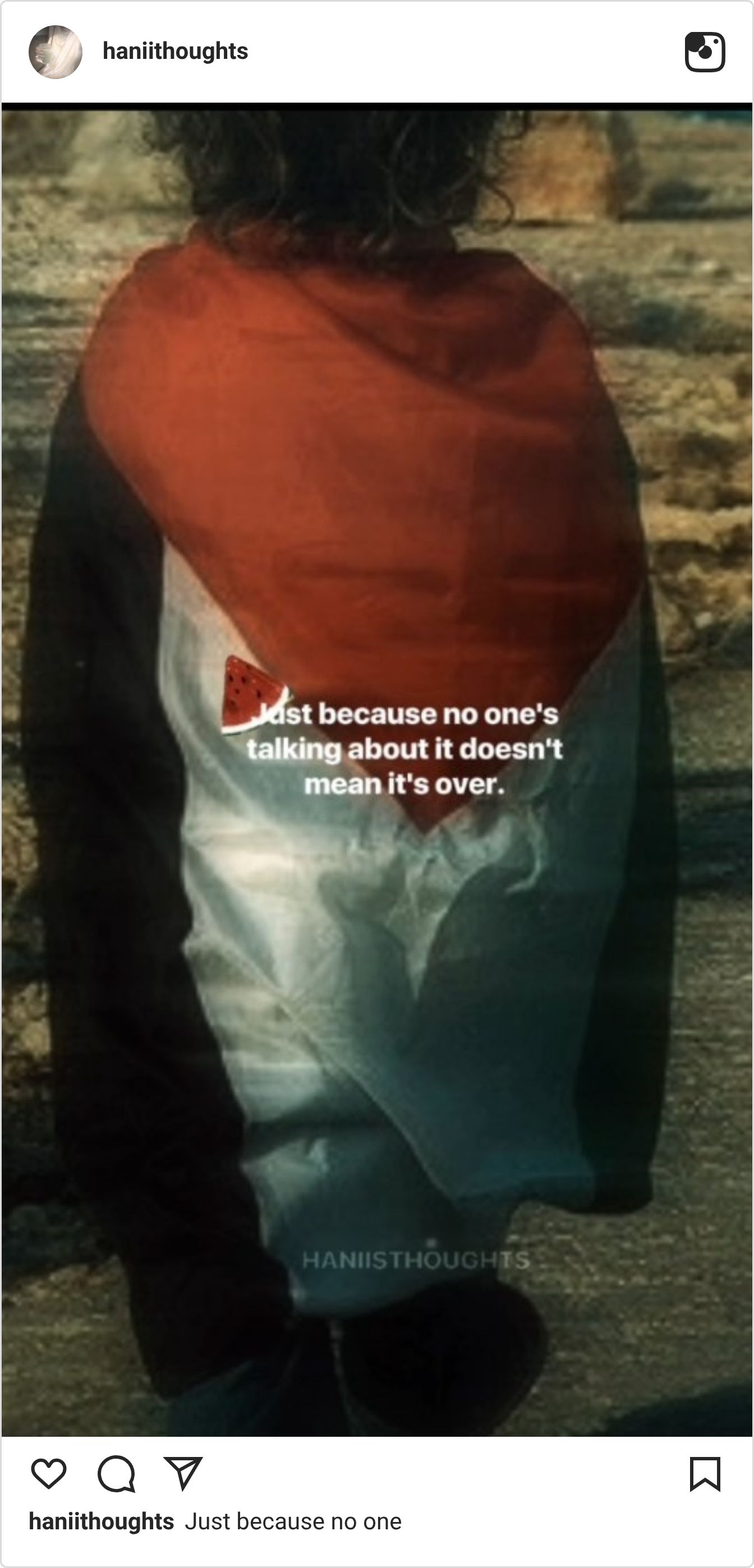
This is the exact point where coverage stops. Nothing is happening, so there’s nothing to report, and the world quietly files it under finished and moves on to the next thing.
Which means they go through the hardest stretch of all, the waiting, with nobody watching at all.
Don’t do that this time.
Don’t mistake quiet for over. Stay with them through the boring part, the part with no footage, the part where a woman is sitting in a tent deciding whether to let her son believe he’s safe.
Our women are still there. They never left and they’re not going to.
Stay with them through the quiet.
For every mother rationing hope this week,
Hafsa